edHelper.com
Solar System
Motions of the Earth


Motions of the Earth
Reading Level
     edHelper's suggested reading level:   high interest, readability grades 4 to 6
     Flesch-Kincaid grade level:   4.1

Vocabulary
     challenging words:    constant, revolution, directly, based, daytime, equinox, rate, opposite, nights, rotation, daily, longer, handle, motion, evidence, amount
     content words:    Arctic Circle


Print Motions of the Earth
     Print Motions of the Earth  (font options, pick words for additional puzzles, and more)


Quickly Print - PDF format
     Quickly Print: PDF (2 columns per page)

     Quickly Print: PDF (full page)


Quickly Print - HTML format
     Quickly Print: HTML


Proofreading Activity
     Print a proofreading activity


Feedback on Motions of the Earth
     Leave your feedback on Motions of the Earth  (use this link if you found an error in the story)


Motions of the Earth
By Patti Hutchison
  

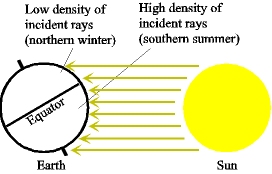
1     The earth is in constant motion. You can't feel it, but we see proof of it every day. The sun, moon, and stars seem to rise and set in the sky. The seasons change as well as the amount of the daylight. These events are all caused by the motion of the earth.
 
2     The earth rotates every day. It spins on its axis. It takes about 24 hours to spin one time around. The rate of movement is about 15 degrees every hour.
 
3     The time it takes from one sunrise to the next is called a solar day. This movement is what causes the sun to appear to move across the sky. It "rises" and "sets" every day. There are different periods of sunlight and darkness around the world. When one side of the earth is facing the sun, it is daytime. On the other side of the earth, it is night. That side is experiencing darkness because it is facing away from the sun. Our timekeeping system is based on a solar day.

Paragraphs 4 to 10:
For the complete story with questions: click here for printable


Copyright © 2009 edHelper