edHelper.com
Life Science
Meiosis


Meiosis
Reading Level
     edHelper's suggested reading level:   grades 6 to 8
     Flesch-Kincaid grade level:   7.53

Vocabulary
     challenging words:    fertilization, mitosis, sperm, survival, clone, crossing, sexual, offspring, division, original, identical, material, divide, exception, reproduce, receive


Print Meiosis
     Print Meiosis  (font options, pick words for additional puzzles, and more)


Quickly Print - PDF format
     Quickly Print: PDF (2 columns per page)

     Quickly Print: PDF (full page)


Quickly Print - HTML format
     Quickly Print: HTML


Proofreading Activity
     Print a proofreading activity


Feedback on Meiosis
     Leave your feedback on Meiosis  (use this link if you found an error in the story)


Meiosis
By Cindy Grigg
  

1     Living things reproduce to make more organisms like themselves. When organisms reproduce, many traits of the parents are passed to the new organism. Reproduction is necessary for the survival of the species. If organisms didn't reproduce, the species would die out.
 
2     Many organisms reproduce by combining cells from two different parents. This type of reproduction is called sexual reproduction. In sexual reproduction, the offspring receive genetic material from both parents of different sexes. Plants, insects, animals, some fungi, and people all make more of themselves by sexual reproduction.
 
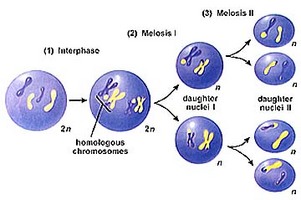
3     Special cells, sperm and egg cells, are used in sexual reproduction. These cells, called gametes, form by a type of cell division called meiosis. Cells formed through meiosis have only half the number of chromosomes or genetic material of the parent cell. For example, most cells of fruit flies have eight chromosomes, arranged as four similar pairs. But the egg or sperm cells of a fruit fly have only four chromosomes. Humans have forty-six chromosomes, arranged in twenty-three pairs. But human egg and sperm cells only have twenty-three chromosomes. How does this happen?

Paragraphs 4 to 9:
For the complete story with questions: click here for printable


Copyright © 2009 edHelper