edHelper.com
Solar System


The Gas Giant Planets


The Gas Giant Planets
Reading Level
     edHelper's suggested reading level:   high interest, readability grades 5 to 7
     Flesch-Kincaid grade level:   5.13

Vocabulary
     challenging words:    microscopic, planetary, nitrogen, hydrogen, orbit, atmosphere, lightweight, helium, particle, revolution, rotation, fluid, violent, mass, equal, rage
     content words:    Hubble Space Telescope, Great Red Spot, Like Jupiter, Great Dark Spot


Print The Gas Giant Planets
edHelper.com subscriber options:
     Print The Gas Giant Planets  (font options, pick words for additional puzzles, and more)

     Quickly print reading comprehension

     Print a proofreading activity


Feedback on The Gas Giant Planets
     Leave your feedback on The Gas Giant Planets  (use this link if you found an error in the story)


The Gas Giant Planets
By Patti Hutchison
  

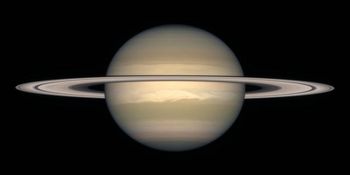
1     Caption: Picture of Saturn from the Hubble Space Telescope
 
2     Jupiter, Saturn, Uranus, Neptune. These are the giant gas planets. Scientists think they are made of small, solid cores. Their interiors are fluid. Lightweight gases such as hydrogen and helium make up most of their mass. With all their satellites and ring systems, they are very interesting to observe.
 
3     Jupiter is the largest planet. It is the fifth from the sun. The length of its year is about 4330 Earth days. This is how long it takes for Jupiter to make one revolution around the sun. It spins very fast, however. It takes only about nine Earth hours for Jupiter to make one rotation.
 
4     Jupiter's diameter is eleven times larger than Earth's. In fact, Jupiter is only ten times smaller than the sun. This giant planet makes up about 70 percent of all the planetary matter in our solar system.

Paragraphs 5 to 12:
For the complete story with questions: click here for printable


Copyright © 2008 edHelper