Sixth Grade
Worksheets
The Schlieffen Plan
Long before the first shots were fired in World War I, plans were being made to win the war. In 1904, ten years before the battles began, France, Great Britain, and Russia decided to form an alliance. These countries had heard rumblings from Germany that frightened them. They felt threatened by the Germans. Germany was building up its army and hinting at the idea that they would like to take control of smaller countries in Eastern Europe. France and Great Britain made an agreement to help each other in the event of a German attack. They decided to include Russia in their agreement. That would mean that the western border with Germany would be protected by France and Great Britain. The eastern border with Germany would be protected by Russia.
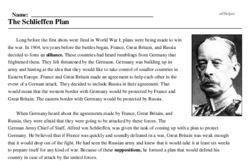
When Germany heard about the agreements made by France, Great Britain, and Russia, they were afraid that they were going to be attacked by these forces. The German Army Chief of Staff, Alfred von Schlieffen, was given the task of coming up with a plan to protect Germany. He believed that if France was quickly and soundly defeated in a war, Great Britain was weak enough that it would drop out of the fight. He had seen the Russian army and knew that it would take it at least six weeks to prepare itself for any kind of war. Because of these suppositions, he formed a plan that would defend his country in case of attack by the united forces.
Schlieffen's plan was fairly simple. Ninety percent of the German army would be sent to attack France. There were French forts on their border with Germany. Schlieffen's plan was to bypass these forts and surprise the French from another direction. His plan sent German troops through Holland, Belgium, and Luxembourg. Germany would take control of these small, weak countries in quick attacks. This would lead them to an unprotected section of France. From this point, they would be able to enter France and take control before the troops on the border had time to make their move. The other 10% of the German troops would be sent to the Russian border. The Germans believed that the Russians would take so long to respond to the Germans, that they would have plenty of time to take control of France and then reinforce their troops on the Russian border.